AMD’s Next Flagship GPU: RDNA 5 (AT0) and Our Bare Metal Roadmap
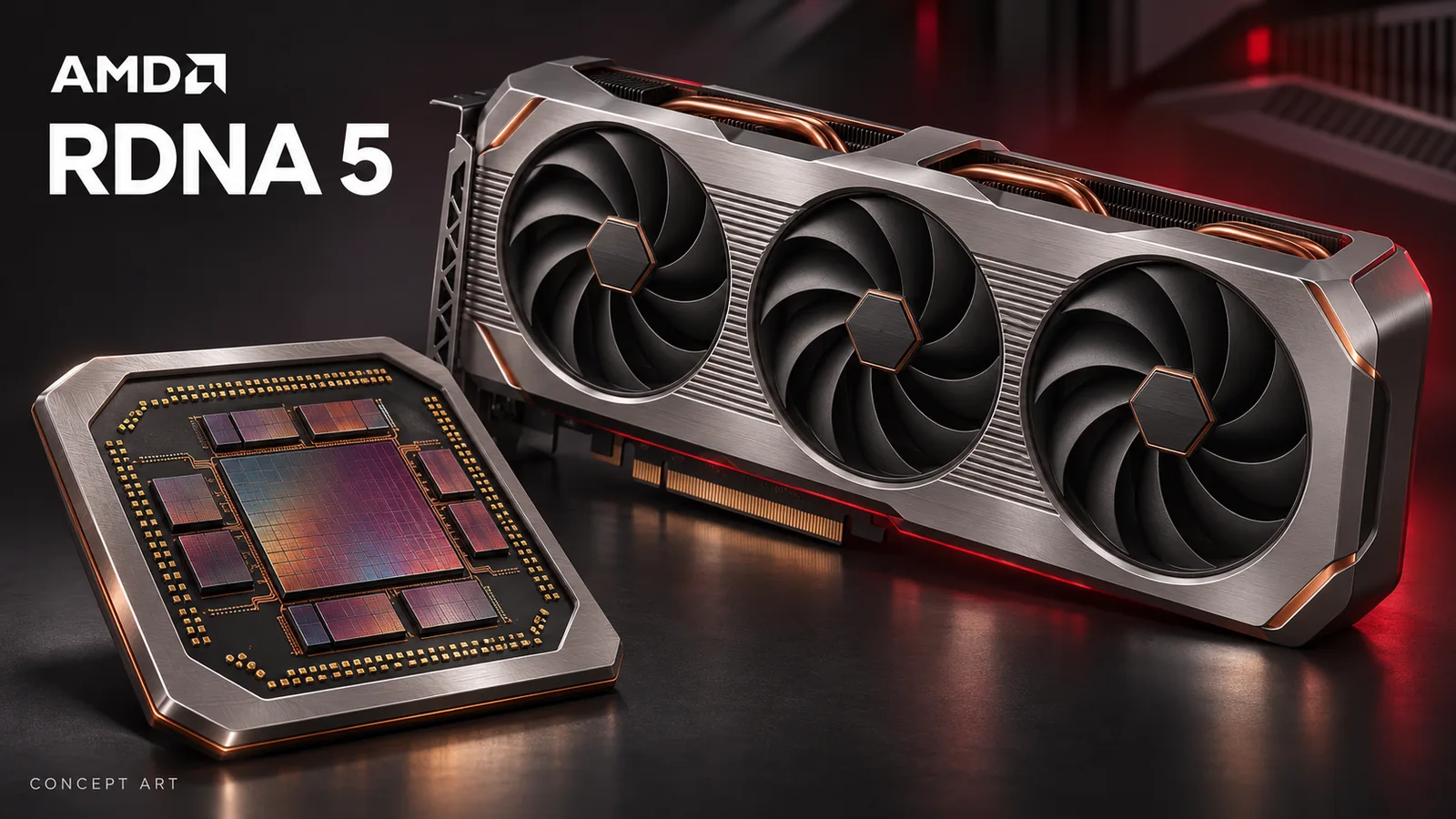
AMD’s next flagship Radeon could be the kind of generational leap that changes which graphics settings you leave permanently switched on. Because AMD focused RDNA 4 on the midrange and upper-midrange segment, its RDNA 3 flagship—the RX 7900 XTX—remained the last true ultra-enthusiast Radeon card. That makes AMD's next architecture, widely tracked as RDNA 5 (or UDNA), the major flagship return to watch. Early leaks point to a restructured compute design, a wider 512-bit memory interface, and major gains in ray-tracing throughput.
At Maximum Settings, we intend to make AMD’s next flagship gaming GPU the centerpiece of a future premium Bare Metal tier—making this generation worth following well beyond the usual spec-sheet wars.
Meet “AT0,” the Flagship in the Leaks
Inside the hardware rumor mill, AT0 is the leaked silicon identifier tied to AMD's highest-end RDNA 5 desktop chip.
Reporting from VideoCardz, drawing on hardware leaker Kepler_L2, describes an AT0 configuration with 96 compute units and a 512-bit memory bus, while a September 2026 discussion noted 3.1 to 3.4 GHz clock targets for the broader RDNA 5 architecture.
| Rumored Detail | Why It Matters for 4K Gaming |
|---|---|
| 96 Compute Units (under new counting) | Rumors suggest AMD is reorganizing how execution units are grouped (96 under the new convention versus 192 under the legacy count), meaning a far larger shader array than previous 96-CU cards. |
| 512-bit Memory Interface | Could provide substantially more memory bandwidth for demanding 4K textures and ray-tracing workloads than a 384-bit bus, depending on final memory speeds. |
| 3.1 to 3.4 GHz Reported RDNA 5 Clocks | Discussed as an architectural clock target (originally in the context of integrated graphics) rather than a confirmed AT0 retail boost clock. |
One crucial detail: the rumored 96 compute units cannot be compared 1:1 with the 96 compute units on the RX 7900 XTX. Underlying forum discussions around AT0 distinguish between 96 units under a new counting convention and 192 under the legacy RDNA convention. Because changes to how AMD organizes its execution hardware make headline CU numbers misleading on their own, final retail specifications and real-world benchmarks will matter far more than simple unit counts.
How Much Faster Could It Be?
Earlier estimates from hardware leaker Kepler_L2 suggested roughly 20% higher raster performance per compute unit over RDNA 4, alongside approximately 2x the ray-tracing and AI performance. Because those figures originated as leaker estimates rather than measured silicon benchmarks, they should be viewed as directional rather than guaranteed gaming results.
Still, looking at how a frame is rendered shows why a "2x ray tracing" jump matters—and what it actually means for frame rates. A GPU spends time on many tasks besides tracing rays. Take a simplified math example: if a 16-millisecond frame (62.5 FPS) contains 8 milliseconds of raster/shading work and 8 milliseconds of ray-tracing work, cutting the ray-tracing time in half drops the total frame time to 12 milliseconds (83.3 FPS). That translates to a ~33% increase in frame rate, not double the overall FPS.
If those architectural improvements reach shipping hardware, they could deliver a major uplift in demanding 4K titles, with the largest relative gains showing up in heavy ray-traced and path-traced workloads.
Why Base Frame Rate Matters in Cloud Gaming
More raw graphics headroom gives you the freedom to push richer lighting, reflections, and higher rendering resolutions while maintaining a smooth frame rate.
For cloud gaming, a high base frame rate before frame generation is the foundation of responsive play. Frame generation can make motion look smoother on screen, but interpolated FPS does not deliver the same input responsiveness as rendering every frame directly—in fact, interpolation adds latency by holding back frames to calculate the in-between image. Spatial and temporal upscaling, by contrast, can genuinely help responsiveness by reducing render time and raising that underlying base frame rate.
When you stream over our Maximizer client, strong underlying rendering performance gives us the headroom to deliver consistent frame times, clean image quality, and responsive play without relying on inflated frame counters.
Real Engineering Behind the Rumors
Some clues go beyond forum leaks. AMD’s own GPUOpen research on Dense Geometry Format (DGF) details a hardware-friendly compressed geometry format intended for future GPU architectures, built to reduce the memory footprint of complex scenes.
Meanwhile, in September 2026, preparatory patches adding GDDR7 to VRAM type definitions landed in AMD’s open-source Linux kernel driver. While these developments do not confirm AT0’s final specifications or launch schedule, they offer a clear glimpse into AMD’s broader engineering direction on Linux.
The Launch Window—and the Cloud Bare Metal Advantage
Recent October 2026 reporting indicates that an RDNA 5 announcement is not expected before Computex 2027 at the earliest, with speculation that midrange chips ("AT2") could arrive in 2027 while the flagship AT0 follows in 2028.
That timeline highlights the practical advantage of Maximum Settings. You can enjoy a dedicated, unshared gaming PC today—where the CPU, GPU, and RAM are yours alone while you play—without buying, maintaining, and deprecating high-end graphics hardware yourself while the next generation takes shape.
What Maximum Settings Will Evaluate
Our plan is to make AMD’s next flagship gaming GPU the centerpiece of a future premium Bare Metal tier, subject to retail availability and our own in-house testing. Before any new hardware hits our racks, we evaluate it across four core pillars:
- Sustained 4K Gaming Performance: Real rendered throughput across demanding raster and ray-traced titles.
- Frame-Time Consistency: Smooth 1% lows and stable pacing without micro-stutter.
- Linux Mint & Proton Compatibility: Rock-solid open-source amdgpu and Mesa driver maturity on bare-metal Linux.
- Maximizer Streaming Quality: Low-latency hardware encoding and crisp visual fidelity over the network.
We will share confirmed account configurations, pricing, and deployment details as those plans develop. In the meantime, explore our current Bare Metal plans and jump into a dedicated cloud rig today.
Don't just play the game. Take it to the Max.